
Outlook for Bahraini banks remains negative: Moody’s
July 9, 2018 | 06:45 PM
July 9, 2018 | 06:45 PM
Last Updated: July 9, 2018 | 06:46 PM

3 minute read
AA
Resize


DIFC, Dubai — The outlook for the Bahraini banking system remains negative, as constrained government spending will weaken economic growth, said Moody's Investors Service in a report published Monday.
The report, "Banking System Outlook – Bahrain; Slowing economy and government spending constraints drive our negative outlook" said "despite a rise in oil prices, the government's budget deficit will oblige it to constrain spending, which will
moderate growth in the non-oil economy. Higher borrowing costs due to rising interest rates, and reduced subsidies will weigh on corporate and household income, putting mild pressure on loan quality.
Problem loans will rise modestly to 6.5% from an estimated 5.8% at the end of 2017.
Pressure on borrowers from higher borrowing costs in a rising rates environment, subsidy cuts and increased exposure to the volatile real estate and construction sectors will be the main drivers behind the increase in problem loans. This will be partly offset by the banks’ ongoing initiatives to recover and write-off legacy problem loans. Bahraini banks’ large exposure tothe government and other public-sector debt will rise further, increasing the linkage between
the banks' credit profiles and that of the government.
“We expect slower economic growth of 2.8% in 2018 (3.9% in 2017), as a result of constrained government spending. The impact will be softened to some extent by ongoing infrastructure projects financed by the Gulf Cooperation Council (GCC) Development Fund
and the resilience of Bahrain’s well diversified non-oil economy.We project annual credit growth to decelerate slightly to around 5%-7% in 2018 and 2019, from 8% in 2017.,” Moody’s said.
In addition, rising government debt is reducing the government's capacity to support the country's banks in a crisis," said Ashraf Madani, a Vice President and Senior Analyst at Moody's, and author of the report.
Moody's expects economic growth to slow to 2.8% in 2018 from 3.9% in 2017 as the government constrains spending, due to its large budget deficit. As a result, credit growth will decelerate slightly to 5%-7% from 8% in 2017.
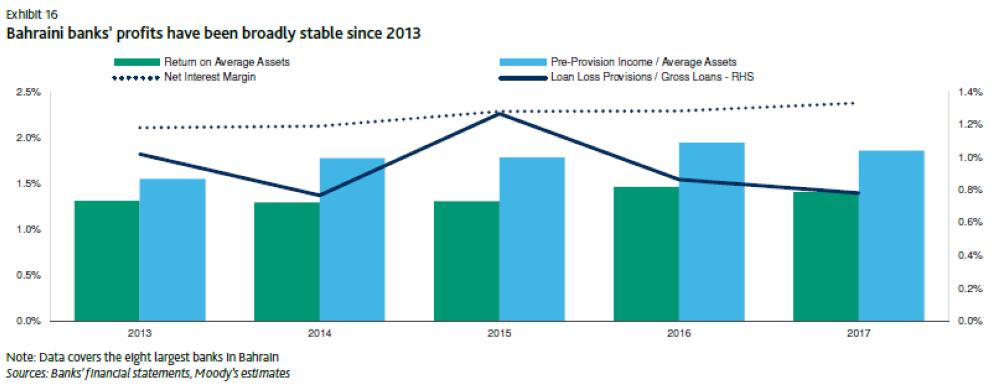
Net income at Bahraini banks will decline slightly to around 1.3% of average assets in 2018, compared with 1.4% in 2017. This is mainly due to higher loan-loss provisions as problem loans rise. Pre-provision profit will likely remain at around 1.9% of average assets benefitting from cost-cutting initiatives.
Nonetheless, capital will remain strong and stable. Moody's forecast that it expects average tangible common equity to remain at 12.3% of adjusted risk-weighted assets, as moderate loan growth is balanced by the banks' strong profit retention. — SG


