
Demonetization woes
Demonetization woes
January 2, 2017 | 12:01 AM
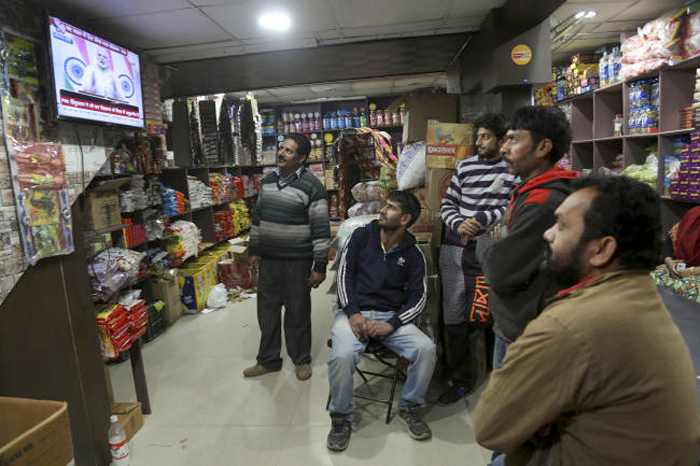
People watch Indian Prime Minister Narendra Modi addressing the nation, on television at a grocery store in Jammu, India
January 2, 2017 | 12:01 AM
Last Updated: January 2, 2017 | 12:01 AM

3 minute read
AA
Resize


All those who listened to Indian Prime Minister Narendra Modi’s address to the nation on New Year’s Eve must have felt terribly disappointed. He was speaking to the Indians for the first time after he announced the scrapping of high value 500 and 1,000 rupee notes on Nov. 8.
Modi had then appealed to the people to bear any pain that such a drastic measure may cause, urging them to “punish” him if he failed to change the situation after 50 days. The self-imposed deadline ended on Friday. The situation created by his policy was expected to return to normal on Saturday. It has not, if reports from India are anything to go by.
So the Indian people expected that their prime minister, in a stocktaking speech, would announce some measures to mitigate the harm his policy has caused. The Indian leader had claimed the decision to scrap the notes will fight corruption and tax evasion. So the people also expected him to narrate the achievements in this area. He did neither. This meant two things. First, the inconveniences the people have been suffering ever since he announced the scrapping of notes are not going to end anytime soon. Second, the measure has not so far produced any positive results.
Modi did, of course, acknowledge the difficulties caused to the people but said the corrupt elements in society, not his policy, were responsible. The only thing he said in connection with demonetization was that banks will resume their normal operations as soon as possible.
This means the ordeal which began on Nov. 9 will continue including the limits imposed on withdrawal of cash from banks as well as ATMs. Weekly withdrawal limit from banks was set at 24,000 rupees. For ATMs, it was 2,000 rupees per day (4,500 rupees per day from Jan.1, 2017). Welfare measures and tax concessions for senior citizens, farmers, pregnant women and homebuyers, while welcome, don’t address the main problem.
To declare that 86.4 percent of the cash in circulation (some 22 billion notes) has suddenly ceased to be legal tender was sure to cause hardship to the people and this is what seems to have created resentment throughout India. We should remember that India is a country where a massive proportion of people do not have proper access to the formal banking system. The economic and social turmoil has been compounded by the fact that the government didn’t print a sufficient amount of the new bills.
While announcing the currency reform, Modi said that the rich will now need sleeping pills, while the poor will enjoy sound sleep. But the reverse has been the case, according to reports.
Indian and foreign media have published many pictures of lengthening queues outside banks. A much bigger problem remains invisible: The people, especially daily wage earners, who have lost jobs because so many businesses are closing. Construction companies are laying off laborers, as they can't get the cash to pay them. Merchants lost sales because customers couldn’t pay. Some resorted to barter.
Modi in his address described the demonetization as the “biggest purification drive” in history. Even some foreign experts have said this is by far the most sweeping change in currency policy that has occurred anywhere in the world in decades.
Unfortunately, neither the government nor banks made adequate preparations to implement a move of this scale. The new notes being printed are a different size and do not fit the ATM machine. Experts say it would take upward of four months to a year before the currency supply was adequately restored even if India’s printing presses were to run 24/7. People wanted smaller currency notes to serve their daily needs. New 2,000 rupee notes are creating problems in daily transactions. In short, India, as Modi’s critics say, has set a good example for other countries of how not to do currency reform.


