
‘Israeli settlements inhibiting the possibility of effective Palestine’
‘Israeli settlements inhibiting the possibility of effective Palestine’
January 17, 2017 | 12:00 AM
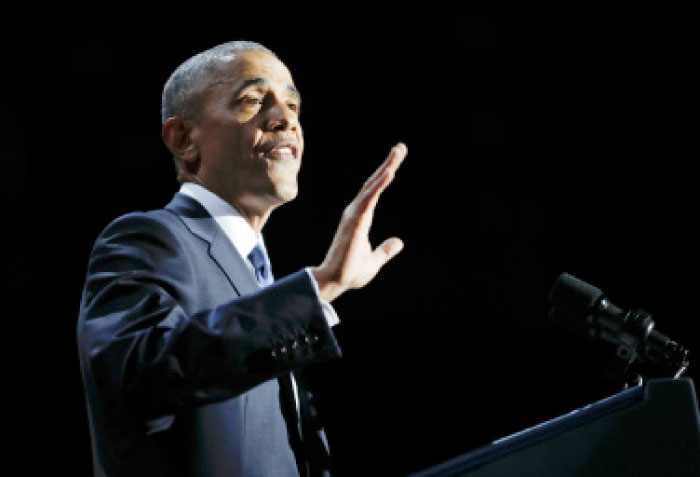
Barack Obama
January 17, 2017 | 12:00 AM
Last Updated: January 17, 2017 | 12:00 AM

3 minute read
AA
Resize


WASHINGTON — President Barack Obama says the increase in the number of Israeli settlements is inhibiting the possibility for an “effective, contiguous Palestinian state.”
Speaking in his final interview as president to CBS’ “60 Minutes,” Obama dismissed the idea that there is a “major rupture” in the relationship between the United States and Israel after last month’s decision by the US to abstain from a United Nations vote condemning Israeli settlements.
The outgoing president reflected during the hour-long interview on his legacy and his biggest challenges during his eight years in office. A number of his policies could be short-lived.
Obama also said that he did not regret his speech drawing a “red line” over Syria’s use of chemical weapons, a phrase critics say symbolizes the US failure to act over the country’s conflict.
Obama made the comment in 2012 about possible US military action in Syria, saying “a red line for us is we start seeing a whole bunch of chemical weapons moving around or being utilized.”
In what was billed as his last network interview, on CBS News program “60 Minutes” broadcast on Sunday — less than a week before his term ends Friday — Obama confirmed that he had ad-libbed phrase, which wasn’t in the text of his speech.
“I don’t regret at all saying that if I saw (Syrian President) Bashar Al-Assad using chemical weapons on his people that that would change my assessments in terms of what we were or were not willing to do in Syria,” he said.
Challenged by his interviewer Steve Kroft that “you didn’t say that... you said — you drew the red line,” Obama declined to say whether he would take it back.
“I think I made a bigger mistake if I had said, ‘Eh, chemical weapons. That doesn’t really change my calculus.’”
“I think it was important for me as president of the United States to send a message that in fact there is something different about chemical weapons,” he added. “And regardless of how it ended up playing, I think in the Beltway, what is true is Assad got rid of his chemical weapons.”
In 2013, the Syrian military used chemical weapons in an attack against rebel-controlled areas of Damascus, killing nearly 1,500 civilians, including more than 400 children.
Wrenching video showing people foaming at the mouth and suffering other effects of an apparent chemical attack caused outrage around the world.
But after it appeared the United States was preparing imminent air strikes against the Syrian government, Washington instead agreed to a last-minute, Moscow-brokered deal to send Syrian chemical weapons to Russia.


