
Lebanon gets a new govt, now it needs a new economy
Lebanon gets a new govt, now it needs a new economy
January 20, 2017 | 12:01 AM
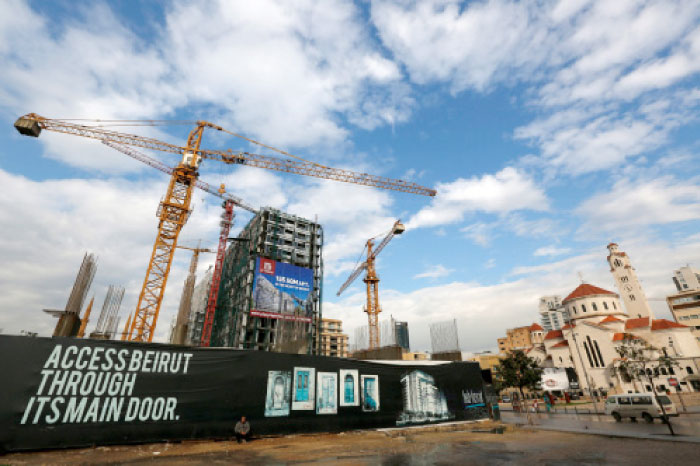
Cranes are seen at a construction site at Beirut’s central district in Lebanon. — Reuters
January 20, 2017 | 12:01 AM
Last Updated: January 20, 2017 | 12:01 AM

3 minute read
AA
Resize


By Lisa Barrington
AFTER years of political deadlock, Lebanon finally has a new government. Now it needs a new economy.
Battered by war in neighboring Syria, neglected by wrangling politicians and caught in regional rivalry, the pillars of the economy — remittances from overseas workers, tourism and real estate — are not what they were.
Long-term, Lebanon is searching for new sources of growth, which fell from 8-9 percent to below 2 percent when Syria’s civil war began in 2011. Beirut is working to start oil and gas exploration, offering support to technology start-ups and urging its vast diaspora to bring their brains and bank accounts home.
But before these dreams can be realized, the government, which started work in the new year after the country spent 2-1/2-years without a president, has an urgent to-do list.
The country’s infrastructure has been awaiting repair since the 15-year civil war ended in 1990: roads are clogged with cars, beaches are littered with waste, internet links are slow or patchy and cuts to power and water supplies are frequent.
Reams of legislation, such as a hydrocarbon industry tax law and the privatization of the stock market, await completion.
Top of Prime Minister Saad Hariri’s list is a budget, which the country has not had since 2005, and a better environment for business, his economic adviser Mazen Hanna told Reuters.
The Cabinet encompasses most sides of the country’s political spectrum and all of its religious sects, making any agreement a challenge. “The first sign of the government’s seriousness is if they will pass a new budget,” Hanna said.
“This is the priority now.”
Without one, there will be little chance of tackling Lebanon’s growing fiscal deficit and debt-to-GDP ratio, forecast by the World Bank at 155 percent this year, the third highest in the world.
The government’s term may be as short as five months if long-overdue parliamentary elections take place on time, but Hanna said it can work on telecoms and the electricity shortages that drive people to hook up to expensive private generators.
It also plans to resolve problems with rubbish disposal which spurred anti-government protests last year and the cabinet includes an anti-corruption minister for the first time.
The fate of Lebanon’s economy is important not only for the livelihoods of 4 million Lebanese, but for avoiding even more chaos in the Middle East: the country is home to more than one million Syrian refugees and half a million Palestinian refugees, and has its own history of instability.
Following its 1975-90 civil war, much of Lebanon’s reconstruction focused on reestablishing its tourism image as “the Paris of the Middle East”, particularly for wealthy Gulf Arabs.
Beirut’s cooler climate and less restrictive social mores are a big draw for people from neighboring Arab countries, but bouts of civil strife, assassinations, deadlocked government and regional rivalries are still taking their toll.
An executive at a luxury hotel in Beirut last summer lamented the dearth of wealthy Gulf Arabs and their $3,000 room service bills.
President Michel Aoun, a Christian ally of Hezbollah, said after a fence-mending visit to Riyadh this month he was confident Gulf tourists would return. — Reuters


