
Trump’s unpredictability puts US friends in a spot
Trump’s unpredictability puts US friends in a spot
January 29, 2017 | 12:02 AM
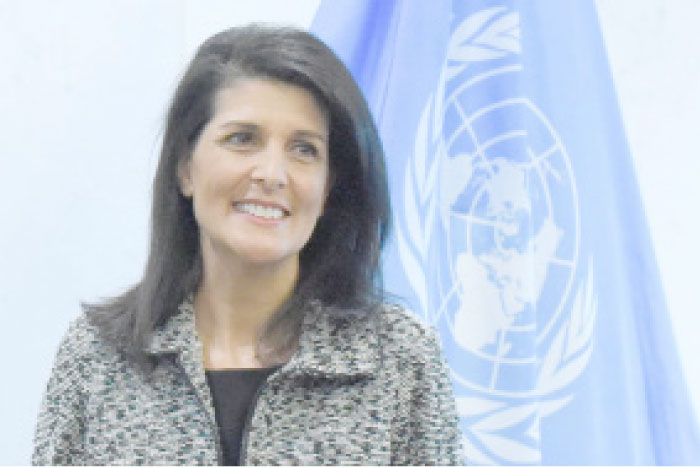
Newly appointed US Ambassador to the United Nations Nikki Haley presents her credentials to UN Secretary-General Antonio Guterres at UN.headquarters in New York City on Friday. — Reuters
January 29, 2017 | 12:02 AM
Last Updated: January 29, 2017 | 12:02 AM

3 minute read
AA
Resize


WASHINGTON — New US President Donald Trump’s “America First” policy has sparked frantic calls to the White House and Congress from diplomats and lobbyists concerned the United States no longer has their back.
When word swirled through Washington on Thursday that Trump might be preparing to ease US sanctions on Russia, worried European diplomats began calling the National Security Council and asking if the rumors were true, said a former US official familiar with the situation.
The White House officials could not answer their questions because they, too, have been kept in the dark, said the former official, who requested anonymity because of the sensitivity of the matter.
Trump’s new United Nations ambassador, Nikki Haley, sent another shiver through America’s allies on Friday, warning them that if they do not have Washington’s back, she is “taking names” and will respond.
“Trump’s foreign policy is totally unpredictable,” said a senior official of the 28-nation European Union, which Trump has said is bound for a break-up.
Defense Secretary James Mattis and Secretary of State nominee Rex Tillerson “have said all the right things,” the EU official said. “But this could be like the Iraq war policy all over again, when we saw how a segment of government decides policy, not the secretary of state.”
Another Western diplomat said foreign ambassadors were explaining their countries’ positions to Congress in the hope that they would find their way to the White House.
Other countries are expanding their lobbying efforts.
At the end of last year, Ukraine signed a $50,000-a-month lobbying contract with Haley Barbour, a former Republican chairman and Mississippi governor.
In January, the government-run China Council for the Promotion of International Trade hired Husch Blackwell LLP, to lobby about the importation of stainless steel, according to records filed with the Department of Justice.
Some uncertainty is normal when a new US president finds his footing and voice on foreign affairs and installs his people in policy-making slots. But in the week since his inauguration, Trump has sent a blizzard of conflicting signals, and key slots at the State and Defense departments and the NSC remain vacant.
“We’re trying to figure out who is who,” one European diplomat said, referring to efforts to determine whether long-standing tenets of US foreign policy still apply.
Presidential spokesman Sean Spicer’s suggestion the United States would stop China from taking over territory in the South China Sea and Trump’s Jan. 2 tweet that a threatened North Korean test of an intercontinental ballistic missile “won’t happen” could raise the chances of a military confrontation, Asian officials said.
Some commentators say it’s too soon for allies to panic.
“It is not appropriate to be too worried, but it is not appropriate not to worry at all,” said Fumiaki Kubo, a professor of American government history at the University of Tokyo.
But others suggested that the greater the uncertainty and the longer it lasts, the greater the chances of miscalculations by other nations that could harm US interests.
The high geopolitical anxiety is most evident in East Asia, where China’s ambitions are colliding with longstanding US dominance in the Pacific. — Agencies


