
Indian govt report plays down hit to growth from cash curbs
Indian govt report plays down hit to growth from cash curbs
February 1, 2017 | 12:00 AM
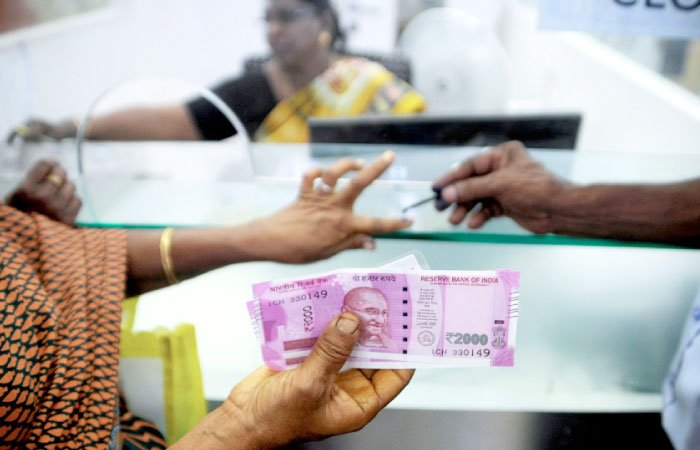
An Indian woman holds Rs2.000 notes as she has her finger marked with indelible ink after exchanging Rs500 and 1000 banknotes at a bank in Chennai in this Nov. 17, 2016 file photo. — AFP
February 1, 2017 | 12:00 AM
Last Updated: February 1, 2017 | 12:00 AM

3 minute read
AA
Resize


NEW DELHI — India’s growth rate will slow by up to half a percentage point due to the government’s decision to scrap high-value banknotes, the top finance ministry economist said on Tuesday, challenging independent estimates of a far bigger impact.
Chief Economic Adviser Arvind Subramanian rejected the view of the International Monetary Fund, where he used to work, that growth would be knocked a full percentage point lower by Prime Minister Narendra Modi’s shock decision in November to scrap 86 percent of the cash in circulation.
Modi launched the “demonetization” drive to expose untaxed wealth and the proceeds of crime and corruption. Yet the measure — unprecedented in a stable, modern, peacetime democracy — has caused huge disruption to daily and business life in Asia’s third-largest economy.
It will also complicate the fiscal arithmetic in Finance Minister Arun Jaitley’s fourth annual budget, which he will present to parliament on Wednesday.
Presenting India’s pre-budget Economic Survey, which combines analysis and forecasts with a broader look at policy issues, Subramanian called demonetization a “radical currency-cum-governance-cum social-engineering measure.”
He also maintained the currency squeeze was “less severe than is commonly perceived.”
Still, Subramanian acknowledged that official GDP figures may not fully reflect the “real and significant hardships” experienced by the informal sector, in which an estimated nine out of 10 Indian workers are employed.
Without giving a figure for growth in the fiscal year that ends in March, Subramanian said it was likely to be between one- quarter and one-half percentage point below an earlier official forecast of around 7 percent.
Growth is expected to “return to normal” in 2017/18, when it is forecast in a 6.75-7.5 percent range, as cash liquidity is restored to the economy, according to the 335-page report.
By contrast, the IMF slashed its India growth forecast for the current fiscal year by a full point to 6.6 percent, handing the title of the world’s fastest-growing economy back to China, which reported 6.7 percent growth for 2016.
Subramanian pointedly declined to comment on whether there had been failings in the planning and implementation of the banknote ban. He expected that a shortage of new 500 rupee ($7.40) and 2,000 rupee notes to end by April.


