
Violence returns to Ukraine
Violence returns to Ukraine
February 2, 2017 | 12:00 AM
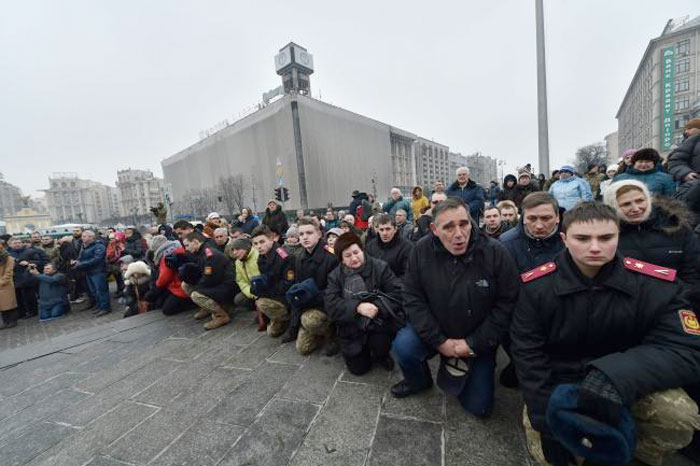
People kneel during a mourning ceremony on Independence Square in Kiev. — AFP
February 2, 2017 | 12:00 AM
Last Updated: February 2, 2017 | 12:00 AM

3 minute read
AA
Resize


It may never be known who fired the first shot that has rekindled the conflict in eastern Ukraine. But the focus now must be on stopping the renewed fighting between separatists and Ukrainian troops in Avdiivka from spreading into a wider and more devastating battle.
This is a small town that has maybe 22,000 inhabitants who find themselves on the frontline between the Russian-backed separatists and the Ukrainian army. The greater part of the town is still in government hands. Kiev says that the separatists began the firefight in which at least seven of its soldiers have been killed. The rebels say Ukrainian forces attacked them and they retaliated.
Whatever the truth, in the midst of ferociously cold winter weather the town’s electricity and water supply has been knocked out and, as ever, it is the civilians who are bearing the brunt of the suffering. The government says it is sending 10 tons of food and blankets as emergency aid, but this would hardly seem sufficient to assist an imperiled population.
What is significant is that the Russians did not use their veto to block a UN Security Council statement warning of a dangerous deterioration in Ukraine and calling for an immediate halt to the battle. Moscow may have a problem with the separatists, some of whom have been highly critical of what they see as a lack of support from Russia. Originally, there were high hopes among the rebels that Vladimir Putin would repeat his coup de main in the Crimea and carve out an autonomous region in Russian-speaking Ukraine. That indeed may have been the Kremlin’s original plan. But international sanctions have certainly hurt Russia, even though it has mounted an adroit campaign to circumvent them.
But then again, it seems equally likely that Putin is still waiting to see the extent of the Trump, rather than the Obama, “reset” in relations between Moscow and Washington. A flare-up on the separatist frontline might have been unwelcome, not least because it would seem to demonstrate that the Kremlin does not have complete control over the rebels. But equally, it might be serving a useful purpose in reminding the new Trump White House that Russia still has a strong hand in eastern Ukraine and is ready to play it if necessary. The EU’s plunging relations with President Trump already threaten to undermine the once united international support for Ukraine. If Trump is prepared to review economic sanctions imposed after Putin seized the Crimea and strengthened after his backing for the eastern separatists resulted in shooting down Malaysian Airlines flight M17, then Brussels could be left in the cold. With the new US president still questioning the value of NATO, fat, prosperous and militarily weak Europe, which has lived so complacently beneath a largely US defense umbrella for over 70 years, is facing some extremely big issues.
Putin’s intervention in Ukraine, as in Georgia in 2008 and to a lesser extent in the Baltic states, has been all about reversing the advance of potentially hostile powers to the very border of Russia. The trigger for the Ukrainian conflict was Kiev’s ambition to join the EU and ultimately NATO. Moscow is no more prepared to tolerate NATO’s nuclear-armed troops on its doorstep than President Kennedy was prepared to allow Russian nuclear missiles in Cuba in 1962.


