
Israel approves 3,000 new settler homes as eviction of wildcat outpost starts
Israel approves 3,000 new settler homes as eviction of wildcat outpost starts
February 2, 2017 | 12:01 AM
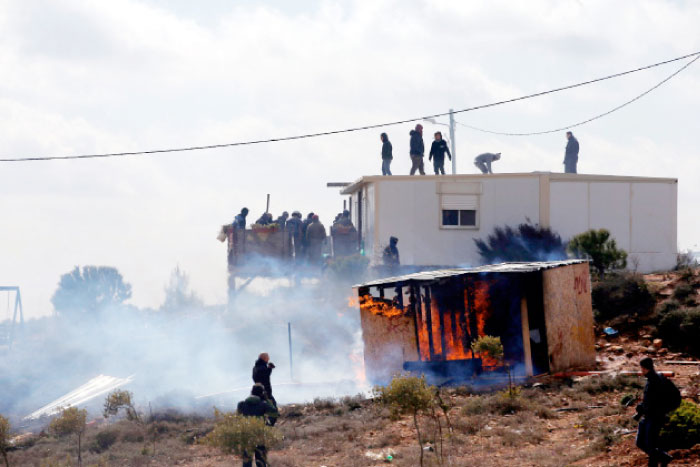
Protesters stand atop a roof and balcony as a shed burns during an eviction by Israeli police of residents from the Israeli settler outpost of Amona in the occupied West Bank on Wednesday. — Reuters
February 2, 2017 | 12:01 AM
Last Updated: February 2, 2017 | 12:01 AM

3 minute read
AA
Resize


Occupied Jerusalem — Israel has unveiled plans for 3,000 new homes for Jewish settlers in the occupied West Bank, the fourth such announcement in the less than two weeks since US President Donald Trump took office.
The late Tuesday announcement came as hundreds of Israeli border police entered a hardline Jewish settlement in the West Bank Wednesday to evict its residents after a court ruled the homes were built on private Palestinian land.
The eviction of the Amona settlement brings to an end months of attempts by the right-wing government to legalize the wildcat outpost.
Hundreds of hardline sympathizers, mainly youths, had earlier slipped past army roadblocks on foot, and lit tires around the outpost.
Some threw stones at the media and border police.
Women holding children began leaving their homes, as youths barricaded themselves in the structures.
Organizers of the protests against the eviction said they would refrain from using violence against the security forces but would not leave of their own volition.
Police said they had been in dialogue with the residents throughout the night in order to ensure “a peaceful eviction, in accordance with their commitment to the High Court,” as part of a deal reached to relocate Amona settlers to a nearby site.
“Police will strive to carry out the eviction without the use of force,” a statement read.
The international community considers all Jewish settlements on occupied Palestinian land to be illegal and regards their construction as the biggest obstacle to a peaceful settlement of the conflict.
Meanwhile, 2,000 settlement units are ready to be put on the market, while the rest are in various stages of planning.
“We؛re in a new era where life in Judaea and Samaria (the West Bank) is returning to its natural course,” said Lieberman, who himself has long lived in a West Bank settlement.
Since the Jan. 20 inauguration of Trump, Israel has approved the construction of 566 housing units in three settlement neighborhoods of annexed east Jerusalem and 5,502 more elsewhere in the West Bank.
On Thursday last week, Israeli officials gave final approval for 153 settler homes in east Jerusalem.
They had been frozen under pressure from the Obama administration, which had warned that settlements could derail hopes of a negotiated two-state solution.
Far-right lawmaker Moti Yogev, whose Jewish Home party is part of Israel؛s governing coalition, was quite open about the trade-off between the Amona eviction and the new settler homes.
Speaking to AFP at the outpost where he had joined residents in a show of solidarity, Yogev said that while evacuating Amona was “a bad decision” which he opposed “We will go.”
“Yes, Amona will be destroyed, but against Amona we are going to build 3,000 new homes.”
“We are building and we will continue building,” Netanyahu said last week.
The accelerated settlement expansion has deeply concerned those seeking to salvage a two-state solution to the Israeli-Palestinian conflict.
The international community considers all Jewish settlements on occupied Palestinian land as illegal and regards their construction as the biggest obstacle to a peaceful settlement of the conflict.
“Defence Minister Avigdor Lieberman and Prime Minister Benjamin Netanyahu have decided to authorise the construction of 3,000 new housing units in Judea-Samaria,” the defense ministry said in a statement, using a term Israel uses for the West Bank, a Palestinian territory it has occupied since 1967. — Agencies


