
Repercussions of the Louvre attack
Repercussions of the Louvre attack
February 5, 2017 | 12:00 AM
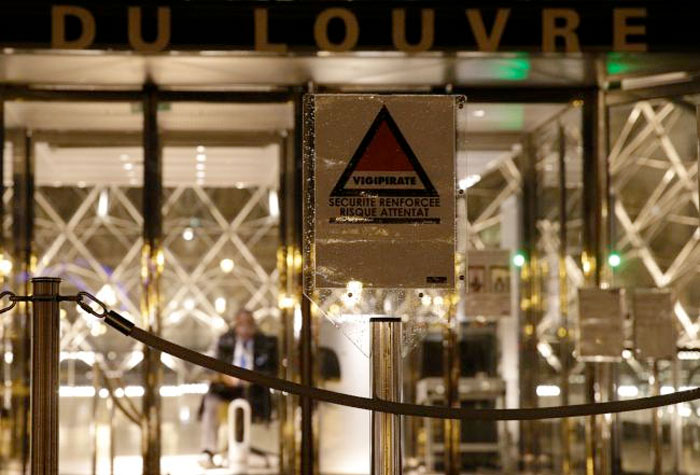
A security guard sits at the entrance of the Louvre Pyramid of the Louvre museum in Paris. — AFP
February 5, 2017 | 12:00 AM
Last Updated: February 5, 2017 | 12:00 AM

3 minute read
AA
Resize


IT might take some time before French authorities uncover the motive behind the Louvre Museum attack in Paris on Friday. They believe the man who tried to attack a security patrol with a machete before being shot and seriously wounded, was a 29-year-old Egyptian who is thought to have traveled to Paris from Dubai on a tourist visa last month. Police are trying to establish if the man, who shouted «Allah Akbar» as he lunged for a security officer who was slightly injured, acted alone or under instructions. The Louvre attack could not have come at a worse time for Paris, coming just hours before the city was unveiling its bid for the 2024 Olympics. Paris is competing against Budapest and Los Angeles for the Games, which it hasn›t hosted since 1924. With the International Olympic Committee choosing the host in September, Friday›s attack generated renewed questions about security in Paris.
The bigger question is how much of an impact will the attack have on the French presidential elections. None of the terrorist attacks that France has witnessed the past two years seemed to have significantly hurt President Francois Hollande; it has been his lack of economic development —- increasing taxes and seeing unemployment go up to 10 percent — that proved his ultimate demise and led to his announcement he would not seek re-election. But security has now become a theme of the French presidential elections slated for April and May. A state of emergency has been in place across France since the Paris terror attacks in November 2015 in which 130 people were killed, the 17 people who were killed in the Charlie Hebdo attack at the start of that year, and the truck attack in Nice in July last year that killed 86 people and injured 200 others.
Far-right National Front leader Marine Le Pen and centrist independent Emmanuel Macron are leading in the polls. There is no denying that the allegedly illegitimate public payments to his wife is a major setback for Francois Fillon and a major boost served up on a silver platter for Le Pen. The Louvre attack can also help Le Pen›s presidential aspirations even more. Macron is emerging as the third man of the French presidential campaign — the only one who can credibly entertain hopes of beating Le Pen to a run-off against Fillon. But he is still far from his double goal — making it past the first round and winning the presidency. There is also the victory of the left under the utopian banner of Benoit Hamon, the unlikely winner of the Socialist Party primary.
An opinion poll published earlier this week suggests that Fillon will not make it to the second round of the election this spring, with Macron predicted to beat Le Pen in the final round. But at the same time, the anti-establishment, populist, anti-immigration movements of Italy›s Five Star and its German counterpart AFD, are allies of Le Pen and Holland›s Geert Wilders of the Party for Freedom, and they are on the rise. Does that make the victory of Le Pen more likely? Will Le Pen’s accession to power be the inevitable conclusion of a process that began with the terrorist attacks, then Brexit and continued with the election of Donald Trump to the American presidency? Certainly, the possibility of a politician of the extreme right making it to the Elysée Palace is real.
The speed with which Paris largely went back to normal after the Louvre attack —- officers dismantled barricades and pulled down police tape around the Louvre just three hours later — underscored how the French authorities and public have perhaps resigned themselves to living with extremist threats. They might simply have gotten used to it. But come election time, the French voter might pull off a surprise that says he is no longer willing to accept the status quo.


