
3 top Philippine officials fly to US carrier in disputed sea
3 top Philippine officials fly to US carrier in disputed sea
March 5, 2017 | 12:03 AM
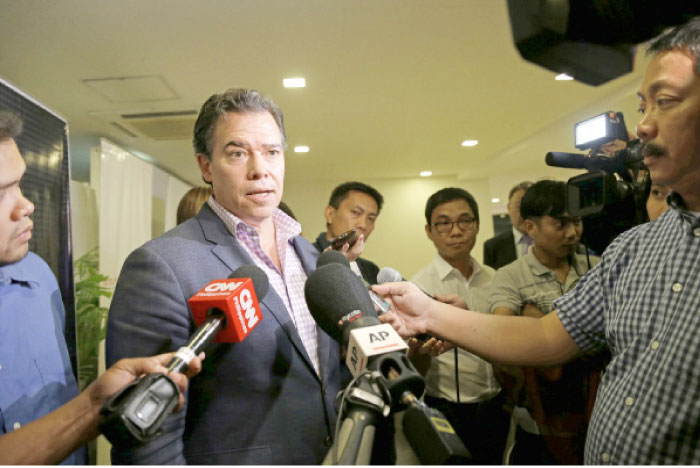
Ernest Bower, a senior adviser for the Southeast Asia program of Washington-based think tank Center for Strategic and International Studies answers questions about disputes on the South China Sea in Makati, south of Manila, on Friday. — AP
March 5, 2017 | 12:03 AM
Last Updated: March 5, 2017 | 12:03 AM

3 minute read
AA
Resize


MANILA — The Philippine defense chief and two other Cabinet members on Saturday toured a US aircraft carrier patrolling the disputed South China Sea on the invitation of the Navy, US Embassy officials said.
Defense Secretary Delfin Lorenzana, Finance Secretary Carlos Dominguez and Justice Secretary Vitaliano Aguirre II visited the USS Carl Vinson along with three Philippine security officials, said US Embassy spokeswoman Molly Koscina.
The visit shows continuing top-level engagements between Philippine officials and the US military despite Philippine President Rodrigo Duterte’s threat to scale back engagements with American forces while reaching out to China and Russia. There was no immediate reaction from China, which had opposed US patrols in waters it has claimed virtually in its entirety.
The US ambassador to Manila, Sung Kim, accompanied the Philippine officials to the Carl Vinson, where they watched F18 fighter jets land and take off on catapult on the flight deck and met US navy commanders in charge of the 95,000-ton carrier as it sailed in the disputed waters, Koscina said.
US Navy officials told a small group of journalists who were flown to the Carl Vinson on Friday that the US warship deployment was aimed at ensuring freedom of navigation and overflight in the South China Sea, a key waterway for global commerce and security.
“We will be here,” Rear Adm. James Kilby told the journalists. “We’re going to continue to demonstrate that international waters are waters where everyone can sail, where everyone can conduct commerce and merchant traffic.”
Kilby’s comments and the presence of the carrier in the South China Sea are aimed at reassuring American allies, who have expressed concerns over China’s aggressive actions to assert its claims to virtually all of the South China Sea.
The nuclear-powered Carl Vinson, which is manned by about 5,500 military personnel, has sailed through the contested region several times and other US warships have routinely patrolled the waters for decades, Kilby said. Sailors expressed confidence and pride in what they do, stepping aside to give way to visitors in narrow corridors.
“Are you enjoying your time on board?” Navy Lt. Charlotte Benbow, who was in charge of the navigation bridge, asked journalists touring the mammoth ship. “Flight ops is pretty cool.”
In recent years, China has turned seven mostly submerged disputed reefs into islands where Beijing is now reportedly installing a missile defense system.
Chinese officials have stressed that they have a right to carry out those constructions in what they say are their territories and add they have no hostile intentions in the region.
But worries over China’s actions have grown. Governments fear its actions could later restrict movement in a key waterway for world commerce with rich fishing grounds and potential undersea deposits of oil and gas.
“There is a lot of worry about what China’s intentions are,” said Ernest Bower, a senior adviser for the Southeast Asia program of Washington-based think tank Center for Strategic and International Studies.
“I think the question everyone has is, ‘(are) the Chinese trying to shut down access to the South China Sea?’” Boyer told reporters in Manila.
“The Americans are saying under no circumstances would that be acceptable to the international community.” — AP


