
China calls for US-North Korea deal to avert ‘head-on collision’
China calls for US-North Korea deal to avert ‘head-on collision’
March 9, 2017 | 12:00 AM
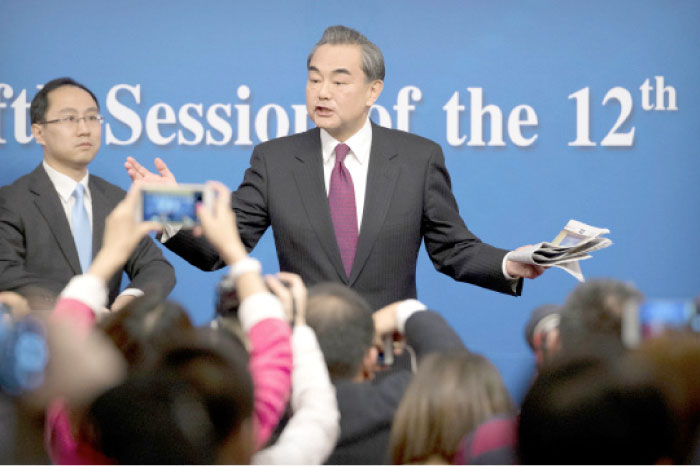
Chinese Foreign Minister Wang Yi gestures as he leaves following a press conference held on the sideline of the National People›s Congress at the media center in Beijing on Wednesday. — AP
March 9, 2017 | 12:00 AM
Last Updated: March 9, 2017 | 12:00 AM

3 minute read
AA
Resize


BEIJING — China on Wednesday called on North Korea to suspend its nuclear and missile activities in exchange for the US and South Korea halting annual military exercises, to prevent what it called a “head-on collision.”
Foreign Minister Wang Yi’s proposal came after a cascade of events that has sent regional tensions soaring, including a volley of North Korean missile tests that flew provocatively close to Japan.
China is particularly concerned over the deployment this week of an American missile-defense system being rolled out in South Korea as a shield against the growing North Korean threat.
Wang warned of a “looming crisis” unless the antagonists cooled down.
“The two sides are like two accelerating trains coming toward each other with neither side willing to give way,” Wang said at a press conference on the sidelines of China’s annual parliament session.
“The question is: are the two sides really ready for a head-on collision? Our priority now is to flash the red light and apply the brakes on both trains.”
He proposed that North Korea “suspend its nuclear and missile activities in exchange for the halt of the large-scale US-ROK exercises,” using the acronym for South Korea.
Pyongyang blasted at least four missiles toward Japan on Monday, three of which splashed down in waters within Japan’s Exclusive Economic Zone.
Seoul and Washington have begun annual joint exercises that always infuriate Pyongyang, and the US has begun deploying its THAAD anti-missile system which, though directed at North Korea, is seen by Beijing as a threat to its own defense interests.
Wang said China’s proposal could help bring the US and North Korea back to negotiations on ending Pyongyang’s weapons programs.
But it mirrors past North Korean offers that were rejected by the US, which said Pyongyang had no right to demand concessions in return for abiding by UN resolutions.
Six sets of UN sanctions since Pyongyang’s first nuclear test in 2006 have failed to halt its drive for what it insists are defensive weapons. It held its most recent nuclear test last September.
Wang continued China’s hammering of the US Terminal High Altitude Area Defense (THAAD) system, which he said “undermines China’s strategic security.”
North Korea has said its missile launches were tests for a possible strike on US bases in Japan.
The UN Security Council on Tuesday strongly condemned the launches as a “grave violation” of its resolutions barring North Korea from developing missile technology.
The Security Council, of which both the US and China are permanent members, denounced Pyongyang’s “increasingly destabilizing behavior” and vowed further measures.
An emergency council meeting has been called for Wednesday.
US President Donald Trump reiterated Washington’s “iron-clad commitment” to Japanese and South Korean security and threatened “very dire consequences” over the launches.
The US State Department said Wednesday that Secretary of State Rex Tillerson will visit Japan, South Korea and China from March 15-19, his first trip to the region.
His talks would focus on “strategic coordination to address the advancing nuclear and missile threat from North Korea.” — AFP


