
With transfer request rejected, teacher unable to take care of sick child
With transfer request rejected, teacher unable to take care of sick child
March 13, 2017 | 12:01 AM
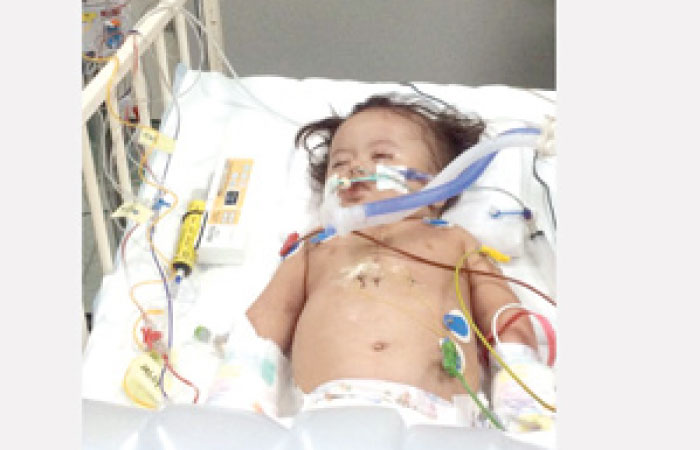
One-year-old Abdullah Al-Harithi remains hospitalized in Taif while his mother is forced to work in a school in Abu Areesh in Jazan region. – Courtesy Al-Watan
March 13, 2017 | 12:01 AM
Last Updated: March 13, 2017 | 12:01 AM

3 minute read
AA
Resize


JAZAN — A secondary school teacher in Abu Areesh governorate has been unable to take proper care of her sick infant because her workplace is far away from the city where the child is receiving treatment, Al-Watan newspaper reported.
Munira Al-Harithi said all attempts by her and her husband, who is an army officer posted on the Kingdom’s southern border, to get her a transfer to a school in Taif have failed. She said her 1-year-old son Abdullah is diagnosed with Down’s Syndrome, as well as a heart defect, and he is in need of specialist medical treatment and parental care.
Hospitals in Jazan have refused to treat the child because of a lack of facilities. Al-Harithi said she had to leave her child in the care of family members to go to work because the authorities have rejected her request for a transfer so that she can stay close to her baby as much as possible.
Capt. Faisal Al-Harthi told Al-Watan that he had submitted several requests with convincing proofs to the authorities to transfer his wife to Taif, where their child is receiving treatment, but all his attempts have so far been in vain.
Explaining the family’s predicament, Capt. Al-Harithi said he and his wife were suffering a lot of mental anguish because they were unable to stay on the side of their child, who is living with the help of medical devices connected to his body at a specialist hospital in Taif.
In addition to this, his wife has been prevented from enrolling for external transportation, which would have helped her commute between Jazan and Taif, said the captain, producing a copy of the letter that he had sent to the authorities requesting his wife’s transfer to Taif.
In response to an inquiry from the Ministry of Education, the Directorate of Health Affairs in Jazan had confirmed the child’s condition.
“According to medical reports the child is suffering from Down’s Syndrome, in addition to Ventricular Septal Defect (VSD). The condition requires treatment at a specialized cardiac center, which is not available in the Jazan region,” the Health Affairs said in its reply.
Speaking to Al-Watan, Dr. Saleh Al-Ghamdi, head of the Department of Psychology at King Abdulaziz University, commented on the case of Al-Harithis and other similar cases.
“This kind of cases can happen and many mothers who are working in remote locations are suffering psychologically because of their inability to take care of their sick children. In Al-Harthi’s case, her son needs special care, which she cannot provide when she works far away from him,” said Al-Ghamdi.
He pointed out that mothers in such cases are exposed to a condition called “psychological exile” because of the mental pressure they go through and they become overly concerned about the welfare of their children.
The psychologist said such mothers eventually become prone to depression because of their feeling of guilt that leads to self-blame, which is one of the negative ways of overcoming the pressures of not fulfilling the obligations of motherhood.
In Al-Harithi’s case this negative feeling can exacerbate further because her husband too lives far away from the family, Al-Ghamdi said.
He appealed to the Ministry of Education through Al-Watan to offer all possible assistance to this teacher after crosschecking her situation and quickly transfer her to a school in a city where her child can receive specialist medical care.
The transfer strategy was adopted by the civil service in order to find quick solutions in situations like this and prevent any negative psychological effects they might have on employee performance, said the psychologist.


