
Merkel makes election pledge of full employment
July 4, 2017 | 12:00 AM
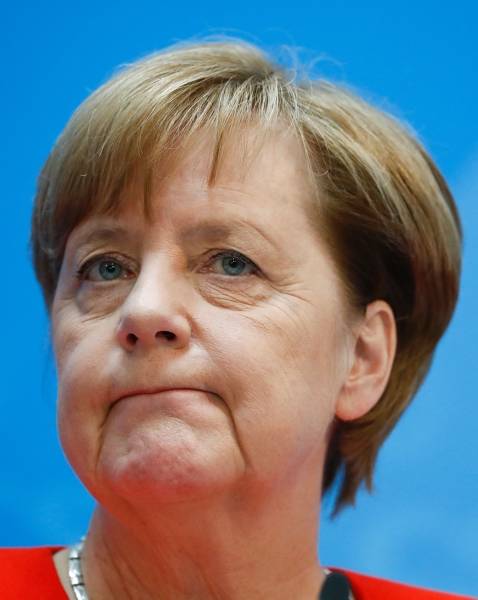
German Chancellor and head of the Christian Democrats party, Angela Merkel and Horst Seehofer (unseen), leader of Bavarian sister Party CSU, give a press conference on July 3, 2017 in Berlin to present their parties’ electoral programs for the September 24 parliamentary election. — AFP
July 4, 2017 | 12:00 AM
Last Updated: July 4, 2017 | 12:00 AM

3 minute read
AA
Resize


BERLIN — German Chancellor Angela Merkel unveiled an ambitious plan to achieve full employment as part of her hotly favored bid to win a fourth term in September elections, hitting back at criticism she was simply content to rest on her laurels.
As she gears up for a high-profile week on the world stage hosting a G20 summit with guests including US President Donald Trump and Russian President Vladimir Putin, Merkel presented a program she said was focused on bolstering Germany’s economic strength and social cohesion.
The clear front-runner in the race for the September 24 poll, Merkel said the signature pledge for her conservative Christian Democrats and their Bavarian allies, the Christian Social Union, would be to slash the jobless rate by 2025 to three percent — defined by economists as full employment — from about 5.5 percent today.
“This is a government program that will bring the country together and not divide it,” she told reporters.
“Our program for Germany is prosperity and security for all,” she said, noting that when she became chancellor in 2005, five million Germans were out of work — more than 10 percent of the labor force.
The sister parties adopted the slogan “For a Germany in which we live well and happily,” transforming the initial letters of the German phrase into a playful, if unpronounceable, Twitter hashtag: #fedidwgugl.
If Merkel completes another four-year term she would match the record set by her late mentor Helmut Kohl, the father of German unity, at whose funeral she spoke at the weekend.
Merkel’s main challenger, Martin Schulz of the center-left Social Democratic Party (SPD), enjoyed a brief surge in the polls earlier this year but is now trailing her party by more than 15 points.
The former European Parliament president launched his campaign one week ago vowing to achieve “more social justice,” with reforms to taxes as well as unemployment and childcare benefits.
But Schulz has found it difficult to get traction with voters against the popular Merkel, with the economy humming and the 2015-16 influx of more than one million refugees now slowed to a trickle.
A frustrated Schulz stunned some observers by accusing the chancellor of an “attack on democracy” by systematically refusing to engage with him in the campaign or make her plans known.
Even an ultimatum on same-sex marriage largely backfired when Merkel suddenly dropped her firm opposition last week, paving the way for a historic vote on Friday with a large majority in parliament to legalize it.
Monday’s program presentation was intended to put some meat on the bones of a election platform that has until now centered almost entirely on Merkel herself as a safe pair of hands in a turbulent world.
“We are looking forward to the future with gusto and we have the strength for it,” a confident Merkel declared.
In a show of unity, the CDU/CSU unanimously approved a manifesto pledging to lower income taxes by 15 billion euros ($17 million) without raising the deficit in Europe’s top economy, offer more financial assistance to families with children, earmark more funds for police and the military and approve a new law to draw more skilled foreign workers to Germany.
Lower taxes promoting higher consumer spending and thereby increased imports were seen as a gesture to foreign critics of Germany’s massive trade surplus. — AFP


