
Holder leads Windies to win over India
July 4, 2017 | 12:00 AM
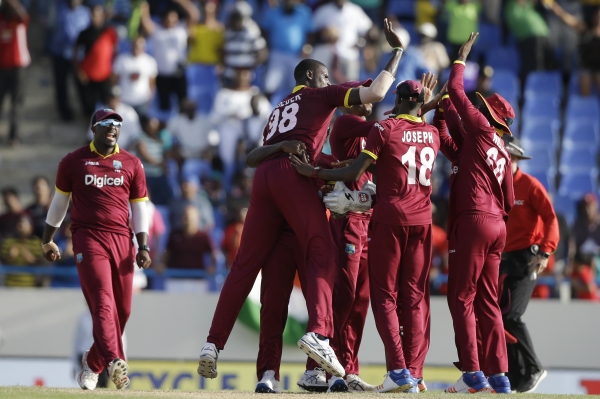
West Indies' captain Jason Holder (98) is surrounded by teammates after beating India by 11 runs in the fourth ODI cricket match at the Sir Vivian Richards Stadium in North Sound, Antigua and Barbuda, Sunday. — AP
July 4, 2017 | 12:00 AM
Last Updated: July 4, 2017 | 12:00 AM

3 minute read
AA
Resize


NORTH SOUND, Antigua and Barbuda — West Indies captain Jason Holder led from the front with a five-wicket haul as his side snatched an 11-run win over India in the fourth One-Day International in Antigua on Sunday.
India came into the match at the Sir Vivian Richards Stadium leading 2-0 in the series and set a modest target of 190 to maintain their unbeaten run in this short campaign. But the visitors were undone by a combination of disciplined West Indies bowling and their own inexplicable lethargy at the crease.
That pedestrian progress was typified by Mahendra Singh Dhoni's painstaking innings of 54 off 114 deliveries — the slowest of his 64 ODI half-centuries — before he fell off the last ball of the 49th over bowled by Kesrick Williams
That left India needing 15 runs off the final over with only two wickets in hand. It was Williams' only success of a miserly 10-over spell but proved critical as Holder sealed the win, which keeps the series alive heading into the fifth and final match in Kingston on Thursday.
He dismissed Kuldeep Yadav and Mohammed Shami in the space of four balls to finish with five for 27, his best-ever ODI figures as India folded for 178. "At the halfway stage there were a few heads dropping in the dressing room but it took a big effort and I'm really pleased to play a part in keeping us in the series," said Holder after receiving the man of the match award.
"We targeted getting wickets at the front to challenge their other batters who haven't had much work to do of late. It worked this time."
Ajinkya Rahane's excellent form at the top of the order continued with a top score of 60, but the rest of the Indian batting struggled to establish any sort of momentum as the West Indies showed discipline and purpose with the ball.
Young fast bowler Alzarri Joseph, brought into the team in place of medium-pacer Miguel Cummins, set the tone for the fightback with the wickets of Shikhar Dhawan and Dinesh Karthik. Meanwhile, Holder removed his Indian counterpart, Virat Kohli, for the second time in as many matches via a top-edged hook.
"Our shot selection wasn't up to mark but credit to the West Indies bowlers for the pressure they put on us to force those mistakes," said Kohli in assessing his team's surprise defeat. "I am sure the guys are going to come back extra hard for the final match. We just needed a complete performance and today wasn't one."
Earlier, pacers Umesh Yadav and Hardik Pandya claimed three wickets each while wrist-spinner Kuldeep Yadav again teased and tormented the West Indies batsmen in adding two more victims to his series haul as the hosts limped to 189 for nine batting first.
While each of the top five managed to get a start, none could get past 35 as India exerted almost complete control over a line-up that lacked the inspirational spark to put the opposition under pressure
Openers Evin Lewis and Kyle Hope were the joint top scorers with 35 apiece although their slow progress — the opening stand of 57 was broken in the 18th over — meant those who followed were required to pick up the pace.
None managed to do so for any sustained period with Pandya and Kuldeep doing the bulk of the damage to the West Indies batting line-up early on.
Umesh then ensured there was to be no threat from the reputed lower-order big-hitters as he accounted for Holder, Rovman Powell and Ashley Nurse in his second spell.
Richards uncertain about S. Africa's transformation plan
South Africa great Barry Richards has questioned whether the current policy of racial transformation will end with "merit selection". The policy is designed to cope with the legacy of apartheid, when largely only white players such as Richards, the outstanding opening batsman of the 1970s, were allowed to play for official South Africa sides.
But the policy and its implementation have proved contentious amid suggestions that players have not always been chosen on merit and that some white cricketers, knowing their chances were in some way restricted, have instead chosen to pursue financially more lucrative careers with English county sides.
However, while transformation has seen the likes of Andile Phehlukwayo and Temba Bavuma possibly get their international chances earlier than expected, both have justified their selections in terms of performance.
Richards, speaking ahead of next week's first Test between England and South Africa at Lord's, accepted it was a contentious issue. "It's a difficult one," said Richards at an event staged by series sponsors Investec.
"South Africa has come from a history of what we know," added Richards, whose own Test career was limited to just four matches because of the apartheid-induced sports boycott of South Africa.
As of last August, Cricket South Africa defined the policy as one where national teams should include on average and across all formats, six players of color, of which two must be black African.
The target at domestic level is a stricter six players of color per side per match, of which three must be black African. But for many years the issue was not so well defined and Richards said: "I don't think they (CSA) make it clear enough to the fans and then you have people on social media having a go at each other."
"From day one, when I came to play county Cricket and I first met Garry Sobers, people like that, picking a team was on merit, I've always been of that opinion," said Richards.
"Whether you can do that in the South African context... I think we're now we're far enough along the line to say we can pick it (the South Africa team) on merit. Where it's causing a problem is a little further down the line.
"Then you've got this transformation policy where an Indian player like Hashim (Amla) becomes different from a black player like (Kagiso) Rabada in terms of team selection. It's a machination of politics and sport, it's always been a mix but never been a great mix.
"The transformation policy, I can see what they are trying to achieve, but whether they achieve the end goal of a merit selection remains to be seen." — AFP


