
Germany survives Chile onslaught to win Confederations Cup
July 4, 2017 | 12:00 AM
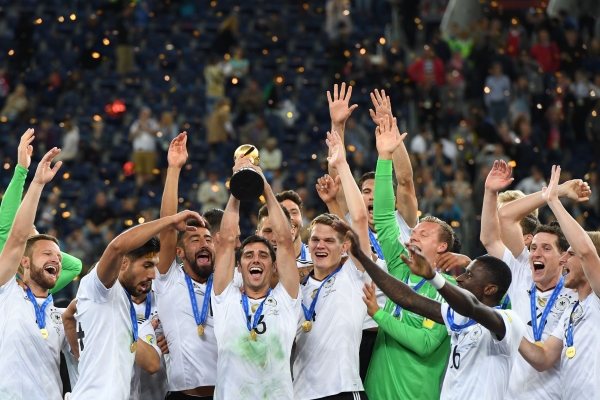
Germany's midfielder Lars Stindl lifts the trophy after winning the 2017 Confederations Cup final football match between Chile and Germany at the Saint Petersburg Stadium in Saint Petersburg on Sunday. — AFP
July 4, 2017 | 12:00 AM
Last Updated: July 4, 2017 | 01:31 PM

3 minute read
AA
Resize


ST PETERSBURG — Germany survived a whirlwind assault by Chile and capitalized on an awful mistake by the South Americans to claim a 1-0 victory in a pulsating, bad-tempered Confederations Cup final on Sunday.
Germany won the title for the first time after Lars Stindl scored the only goal in the 20th minute when Chile midfielder Marcelo Diaz gave the ball away on the edge of his own area.
Chile, playing with their trademark high octane style and driven forward by another relentless display by Arturo Vidal, dominated the match but were let down by poor finishing.
A dramatic game featured missed chances, defensive howlers, scuffles and two video reviews, one producing a highly controversial outcome in the second half.
Chile defender Gonzalo Jara elbowed Timo Werner by the touchline and Serbian referee Milorad Mazic, alerted by the video assistants, let him off with a yellow card instead of a red.
Shortly afterwards, Mazic turned down Chilean appeals for a penalty, stood by his original decision after another review incident and booked Eduardo Vargas for drawing an imaginary television screen.
It was a remarkable achievement for Germany to lift the trophy with a young, experimental squad, although it could also be a bad omen as no team has ever won the World Cup after winning the Confederations Cup the year before.
"The fact that these young players have won this tournament makes it an historic achievement, it's unique in Germany's history, it's outstanding," said Germany coach Joachim Loew.
Chile flew into the game in their inimitable style and Alexis Sanchez should have put them in front, but shot wide from close range after keeper Marc-Andre ter Stegen parried Vidal's shot.
Germany struck almost immediately as Diaz lost the ball on the edge of his penalty area to Timo Werner who slipped it through for Stindl to score into an open goal.
Chile kept missing their chances, continued to look vulnerable on the break and nearly gifted Germany another goal before halftime when Jara gave the ball away in defense, but this time Claudio Bravo saved Leon Goretzka's shot.
Germany were happy to contain Chile and play on their mistakes in the second half, although they were living dangerously at times.
Substitute Angelo Sagal scooped the ball over the bar from close range and Ter Stegen pushed away an Alexis Sanchez free kick in almost the last action of the game.
"We put our ideas into practice," said Chile coach Juan Antonio Pizzi. "We took the initiative, we took control and created chances.... but because of one of those things, those accidents, that happen in football, it was our turn to lose."
"Our gameplan is always to have the initiative, to take the leading role, have control and create openings," coach Juan Antonio Pizzi told reporters after his side lost 1-0 to Germany. "Our commitment in the future is to continue doing the same."
Chile were once renowned as relative lightweights in South America but in the last few years have become one of the continent's most inventive and versatile sides, with a readily identifiable whirlwind style of play.
They invariably press high and try to win possession deep in the opposition's half and, when they have the ball, throw players forward in numbers in a manner which former Spain coach Vicente del Bosque once said was like "facing 11 kamikazes."
Despite their two titles, Chile often threaten to blow themselves out and recent results have been inconsistent.
They still have a fight on their hands to qualify for next year's World Cup, currently lying fourth in the 10-team South American group where only the top four qualify directly.
Pizzi admitted that poor finishing let them down in Russia.
"Converting your chances is one of the most difficult things to do in football, and when you take them, it completely changes the course of the game," he said, adding that his team did not know how to play any other way. — Reuters


