
Indian PM heads to Israel, lifting curtain on close ties
July 4, 2017 | 12:00 AM
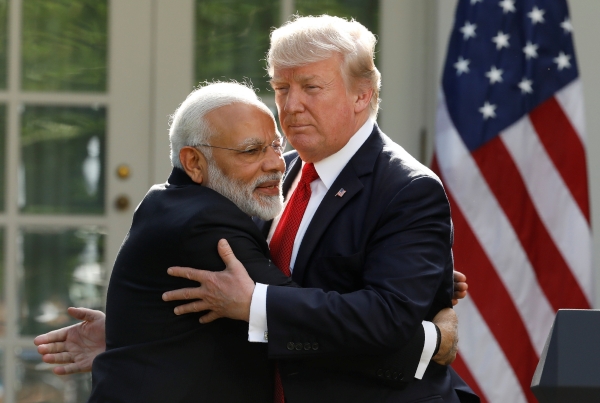
India’s Prime Minister Narendra Modi hugs US President Donald Trump as they give joint statements in the Rose Garden of the White House in Washington in this June 26, 2017 file photo. — Reuters
July 4, 2017 | 12:00 AM
Last Updated: July 4, 2017 | 12:00 AM

3 minute read
AA
Resize


NEW DELHI/TEL AVIV — Narendra Modi begins a first visit to Israel by an Indian prime minister on Tuesday, in a public embrace of a country that he has long admired for its military and technical expertise but which his predecessors kept at arm’s length.
India has traditionally trodden a careful diplomatic line in the region, analysts say, wary of upsetting Arab states and Iran — upon whom it relies for its vast imports of oil — and its large Muslim minority. It has been a vocal supporter of the Palestinian cause, even as it quietly pursued ties with Israel.
But now Modi is lifting the curtain on a thriving military relationship. He will hold three days of talks with his Israeli counterpart, Benjamin Netanyahu, to advance sales and production of missiles, drones and radar systems under his signature “Make in India” drive, officials in Delhi and Tel Aviv said.
Netanyahu, hailing what he described as Modi’s “historic visit,” said on Monday he and the Indian leader have worked together over the past few years to build a “steadfast friendship” between Israel and India.
“This visit will deepen cooperation in a wide range of fields — security, agriculture, water, energy — basically in almost every field Israel is involved in,” Netanyahu told his cabinet in public remarks.
Modi will not travel to Ramallah, the seat of the Palestinian Authority and a customary stop for visiting leaders trying to maintain a balance in political ties.
At home, the apparent shift in what has long been a bedrock of India’s foreign policy risks sharpening criticism that the country’s 180 million Muslims are increasingly being marginalized under Modi’s Hindu-nationalist Bharatiya Janata Party (BJP) government, which swept to power in 2014.
“Narendra Modi’s visit to Israel will only strengthen its occupation of Palestine,” said Asaduddin Owaisi, a member of India’s federal parliament from a regional group that promotes Muslim rights.
In previous decades, under the left-leaning Congress Party, former Palestinian leader Yasser Arafat was a regular visitor to New Delhi, pictured hugging then Indian Prime Minister Indira Gandhi when the two were championing the Non-Alignment Movement.
In May, Modi hosted Arafat’s successor, Palestinian President Mahmoud Abbas, and offered help in health and information technology, but the trip was low-key.
The scale of the ongoing collaboration with Israel dwarfs anything India is attempting with the Palestinians, officials say.
“We have a wide ranging partnership with Israel that ranges from agriculture cooperation to homeland security,” said Bala Bhaskar, head of the foreign ministry’s West Asia division.
He said India’s ties with Israel and Palestine were important in their own right and neither should be viewed through the prism of the other. But an Israeli diplomat said Modi’s standalone trip to Israel was an important signal.
The two sides are expected to announce strategic partnerships in areas including water, agriculture and space technology during Modi’s visit.
But it is the defense relationship that is most advanced — India is now Israel’s biggest arms market, buying weapons at an average of $1 billion each year. — Reuters


