
Innovative technology key component advancing economic growth & environmental sustainability
July 7, 2017 | 12:00 AM
LG
July 7, 2017 | 12:00 AM
Last Updated: July 7, 2017 | 12:00 AM

3 minute read
AA
Resize


THE reliance on technology to solve environmental problems around the world has seen a pragmatic evolution during the last couple of years. Historically, new technologies have evolved in response to population growth, economic pressures and demands for increased safety, better health, more nutritious food, economic welfare, security, and a sound environment.
Technological advances have made possible new sources of energy, new materials, improved health care, increased industrial productivity and food supplies, global communications, and remediation of environmental damage. Many aspects of economic development and environmental protection would not be possible without technology.
According to a latest report by the World Energy Council, the demand for electricity would double by 2060, requiring greater infrastructure investment in smart systems that promote energy efficiency.
Electricity is one of the most important advances that science has given to mankind. Without electricity, society as we know it would cease to exist. It’s very hard to overestimate just how important electricity is to nearly every aspect of modern life, from keeping the lights on in a child’s bedroom to powering massive manufacturing facilities. For countries, then, securing adequate supplies of electricity is a paramount task. Reliable, abundant electricity enables a higher quality of life for citizens. It is also a prerequisite for creating economic growth.
Change comes about from global leaders including corporations
There is a problem, of course. Electricity supplies are limited. Past and current efforts to increase supply and meet the demands of greater energy consumption have had a significant, negative impact on the environment. Our drive for energy is accelerating climate change and exacerbating environmental problems such as acid rain. It is a global issue that requires innovative responses from global leaders.
The term ‘global leaders’ is not restricted to politicians. Corporations also have a responsibility to balance opportunities for growth with the need to seek out eco-friendly paths to achieve that growth. And in some cases, corporations are better poised than many countries to tackle such a large-scale problem. While driven primarily by the need to make greater and greater profits in the past, the growing awareness of climate change has caused pressure, from both within and without, to be placed on corporations to become part of the solution rather than the problem.
Even more interestingly, a number of these corporations have come to the conclusion that becoming part of the solution does not have to come at the cost of profit. In fact, the opposite may well be the case.
Innovation for managing energy
consumption starts from home
Homes consume large amounts of energy. Each household has a collection of home appliances and digital services. It has been estimated that more than 25 percent of the world’s energy consumption is being used for the heating, ventilation and air conditioning (HVAC) as well as the lighting of residential and commercial buildings. Therefore, by concentrating on making this aspect of human life more efficient and less wasteful, there are significant gains to be made in protecting the environment.
Air conditioners in use today work on the same principle as refrigerators, but instead of dumping the heat into the room (which is what happens at the back of a refrigerator) it is sent outdoors. Air conditioners use a lot of electricity because they involve repeated cycles of compressing a gas to a liquid, and that consumes power.
Because much global economic development has happened, and will happen, in hot climates, the demand for air conditioning can be expected to increase markedly over the coming decade; therefore, there is a need for a much more energy efficient way to accomplish space cooling.
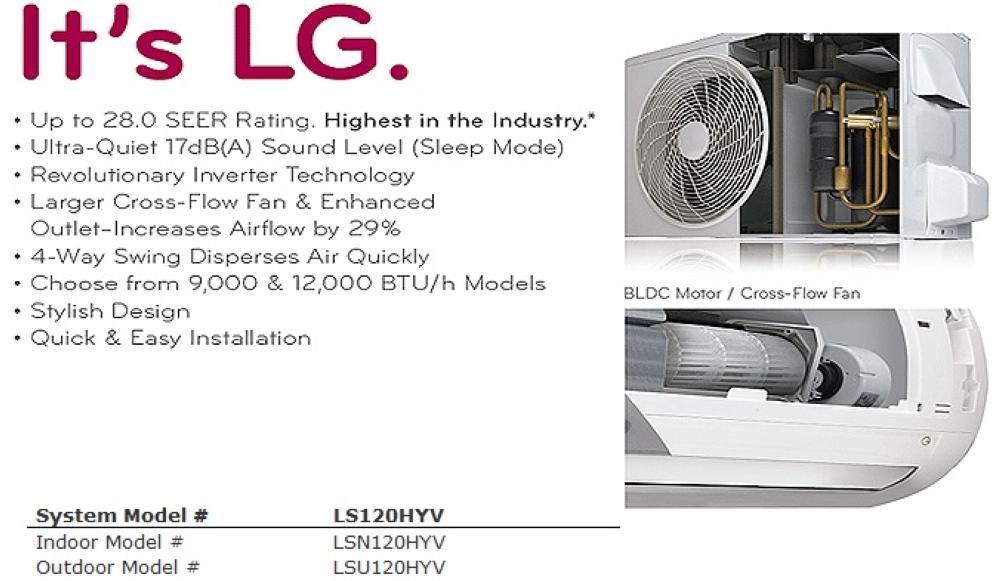
In this regard, new air conditioners with energy saving capability have been identified as the truly next generation air conditioners. When compared with conventional air conditioning units, inverter air conditioners like those of LG Electronics take advantage of unique technological innovations that can control cooling and heating appropriately based on the ambient temperature. These energy efficient air conditioners achieve strong performance levels while at the same time cutting back on the amount of electricity being used.
Energy efficiency of A/cs is
measured by SEER system
The SEER rating of a unit is the cooling output during a typical cooling-season divided by the total electric energy input during the same period SEER rating reflects overall system efficiency on a seasonal basis. The Seasonal Energy Efficiency Ratio (SEER) is a metric used to measure how much cooling a system puts out for each unit of energy it consumes. In theory, the higher the SEER rating, the more efficiently the air conditioner operates.
But the air conditioner that’s right for the home won’t always be the one with the highest SEER rating. The size and age of a home as well as how it is sited and more, need to be factored into the decision. In order to be ENERGY STAR qualified, an air conditioner must have a SEER rating of 14.5 or higher.
Efficient air conditioning is not only better for the wallet, it’s better for the environment. Faster cooling or heating is not restricted to small rooms. Even wider spaces can be climate controlled in shorter times. Customers get to feel better about doing their part to achieve more eco-friendly lifestyles, but they also get the enjoyment of seeing lower electricity bills each month. This is win-win.
To conclude, it is clear that the human race faces a global environmental problem. To help alleviate this situation, global leaders must advocate, corporations must innovate, and consumers in the end must execute with smart purchases. It is with such a group effort that we can only sustain economic growth as well as environmental sustainability. — SG


