
Trump posthumously pardons controversial baseball legend Pete Rose
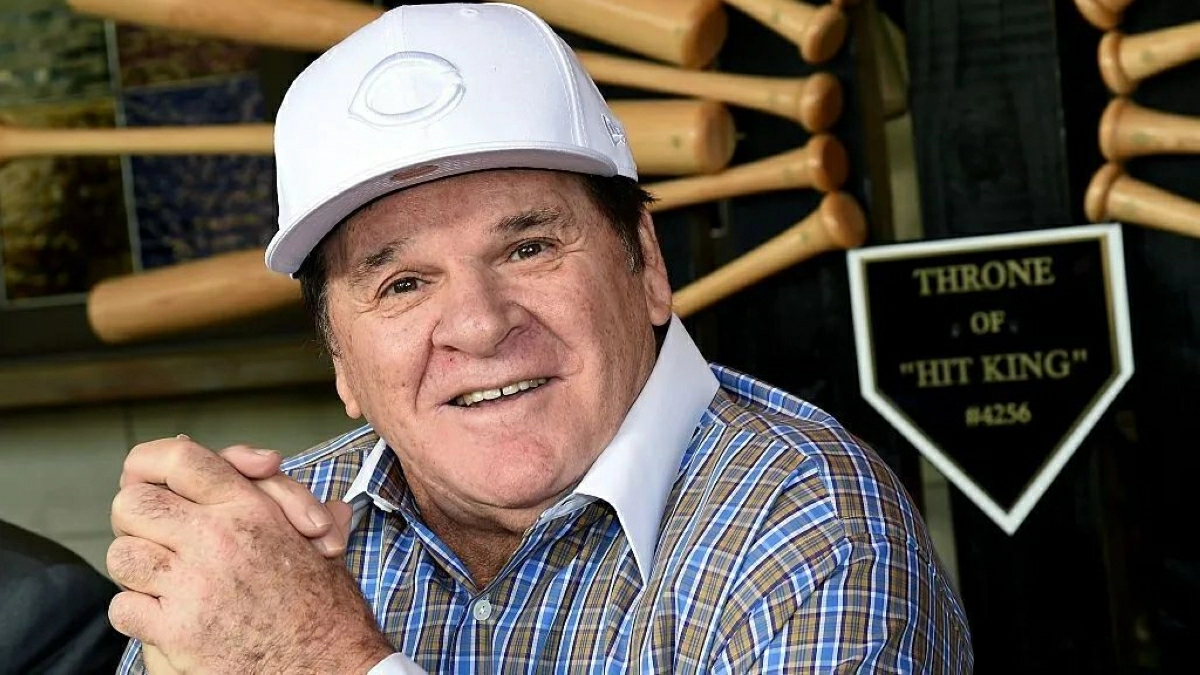


WASHINGTON — President Donald Trump announced on Thursday that he had given a “Complete and Total Pardon” to Pete Rose, after saying for more than a year that he felt the controversial baseball legend was treated unfairly for gambling on games.
Trump announced the posthumous pardon in a social media post from Air Force One as he flew home from his whirlwind trip to Asia.
“I have just given a Complete and Total Pardon to the Late, Great Pete Rose, a true Baseball SUPERSTAR & LEGEND, whose record of 4,256 Hits in a Season will never be broken,” Trump wrote on Truth Social, listing several of Rose’s stats and accomplishments.
In fact, Rose accumulated a career total of 4,256 hits, collected over 24 seasons, which is more than any other player. He played a total of 3,562 games.
Rose, who died in 2024 at the age of 83, pleaded guilty in 1990 to two counts of filing false tax returns. He was also given a lifetime ban from Major League Baseball (MLB) after an investigation revealed he bet on games.
The baseball star was posthumously reinstated to MLB, in which he played for 24 seasons, last year and made eligible for the Baseball Hall of Fame.
The president went after Major League Baseball, writing that Rose, “just like the Great Roger Clemens, who won 354 games, was treated terribly by Major League Baseball in not allowing him to go into the Baseball Hall of Fame.”
“Politics, I guess! Thank you for your attention to this matter,” Trump concluded.
It’s far from the first time the president has brought up Rose, who was famously banned from the league in 1989 for accusations of gambling on the game as a player and manager and later convicted of tax evasion. Rose later admitted to gambling but said he never bet against his own team.
In early 2025, Trump telegraphed his intention to pardon Rose, saying at the time that he would sign a pardon “over the next few weeks.” At the time, Trump said the league lacked “the courage or decency” to put Rose in the Hall of Fame and pushed it to give him the sport’s highest honor after his death.
And MLB commissioner Rob Manfred said in June 2025 that the president was influential in the decision to remove Rose from the MLB’s permanently ineligible list.
More recently, the possibility of a pardon has been brought up publicly to Trump several times this month. When he held an impromptu press conference at the White House with UFC CEO Dana White, a reporter asked about a pardon for Rose. Trump questioned if Rose had ever been criminally charged, and the reporter responded he’d been convicted of tax evasion.
“I’d give Pete Rose a pardon,” Trump replied, continuing: “I think Pete Rose was very mistreated. But he was gambling on his own team, Dana. He wasn’t gambling against. That’s different.”
Conservative radio host Hugh Hewitt also suggested a Rose pardon to Trump during an interview last week.
The three-time World Series champion pleaded guilty to tax evasion and served five months in a federal prison camp in Marion, Illinois, between August 1990 and January 1991.
The historic decision to take Rose off the ineligible list meant Rose could be considered for the Hall of Fame. That honor had been ruled out under the settlement Rose reached with the league. Rose died in September 2024, and Manfred ruled that his lifetime ban ended with his death.
Trump has also brought up Rose in other gambling controversies. This spring, he was asked in the Oval Office about a US special forces soldier charged with using classified information to win about $400,000 on Polymarket by betting on the US military operation to capture Venezuelan leader Nicolás Maduro.
“That’s like Pete Rose betting on his own team,” Trump said dismissively. “Now, if he bet against his team, that would be no good.”
The US Constitution gives a sitting president the broad power to grant a pardon, which represents legal forgiveness and ends any further punishment.
Because Rose's pardon was issued after his death, it is largely symbolic and does not change Rose's Hall of Fame status. The Department of Justice (DoJ) typically does not process posthumous pardon applications, though presidents have still issued them.


