
Eisenkot and Golan reach coalition deal in bid to replace Netanyahu
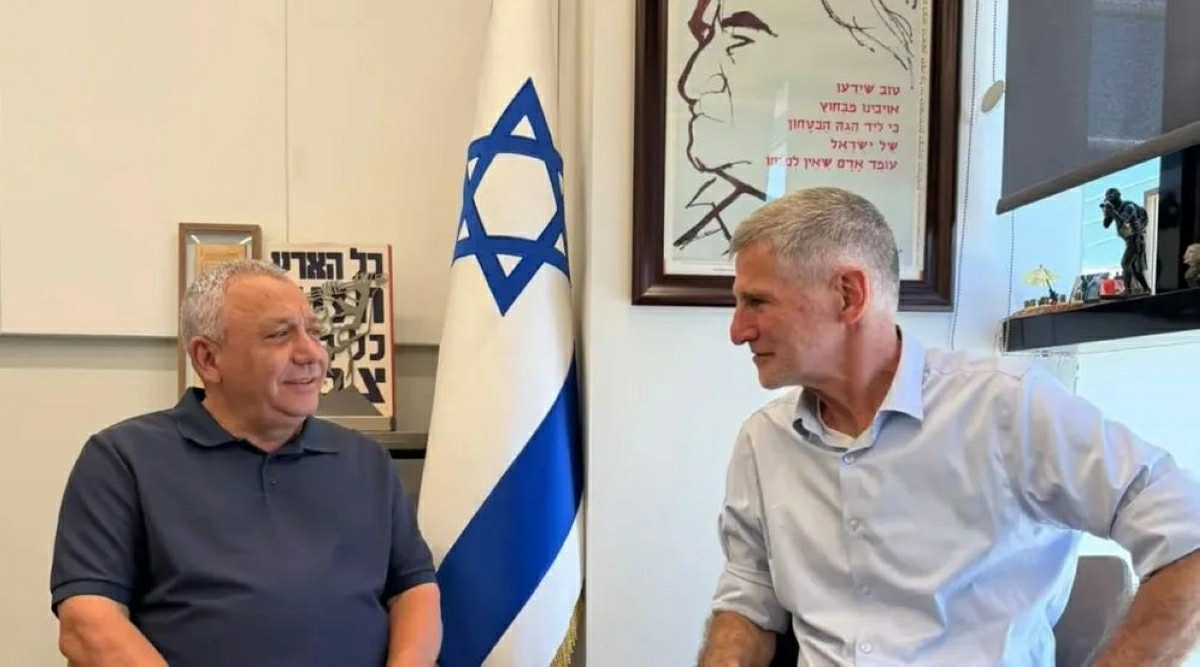


JERUSALEM —Gadi Eisenkot's centrist Yashar party and the Democrats led by Yair Golan announced on Thursday they had agreed on a coalition deal, marking a further step toward forming the next Israeli government.
The left-leaning Democrats are the second party to agree to a coalition deal with Eisenkot’s Yashar after the right-wing Israel Beiteinu party did so on Tuesday.
Eisenkot has until December 6 — a deadline which can be extended by 14 days — to form a government to replace Prime Minister Netanyahu after the October election failed to deliver a clear majority for either bloc.
“Gadi Eisenkot, chair of Yashar with Eisenkot, and Yair Golan, chair of the Democrats, have agreed to sign a coalition agreement between the two parties,” a joint statement said on Thursday.
The announcement comes just hours after Yashar announced the resumption of coalition negotiations with the party, after Golan froze them on Tuesday ostensibly in protest of Yashar’s ongoing negotiations with Benjamin Netanyahu’s Likud over the formation of a possible unity government.
Israeli media reported that disputes centered over the allocation of ministerial portfolios.
Yashar struck the coalition agreement on Thursday, with the left-wing party set to receive four ministerial portfolios, according to a statement issued by the Democrats.
According to the statement, the four portfolios are an “expanded” national security portfolio; labor and welfare — currently two separate ministries slated to merge as part of the Eisenkot-led bloc’s plans to pare down a bloated government; communications; and culture and sports, with the latter encompassing “a new democracy directorate.”
The party will also oversee the Social Equality Ministry, though the wording of the statement suggests that it will be merged into one of the four portfolios, most likely labor and welfare.
Eisenkot, Liberman and Golan have a combined total of 36 lawmakers — far short of the 61 needed for a parliamentary majority.
Eisenkot’s bloc also includes the Beyachad party of former prime minister Naftali Bennett, which has 12 seats but is yet to sign a formal coalition agreement with Yashar.
Eisenkot’s wide-ranging anti-Netanyahu camp has faced divisions on whether to forge alliances with the ultra-Orthodox parties, or the Arab-majority lists, or whether to form a national unity government with Netanyahu’s right-wing Likud.
The Democrats have been pushing Eisenkot for a coalition with two Arab-majority lists that achieved an unprecedented seat haul in the vote, in a bid to unseat Netanyahu.
The party viewed the four rounds of talks between Yashar and Likud unfavorably in recent days over the possibility of a unity government. No breakthroughs on that front have ostensibly been reached.
Liberman on Thursday warned that Netanyahu was trying to derail the government’s formation.
“He will drag out negotiations over a ‘unity’ government until the last moment, look for a pretext to blow them up, and even if such a government is formed, he will try to engineer a crisis within a few months to drag Israel back to elections,” added Liberman, a hawkish former aide to Netanyahu who has become a strident critic.
Liberman has refused to serve in a government that relies on Arab-majority parties and has instead advocated an alliance with the two ultra-Orthodox parties, despite his years of criticism of the community and the fact that the issue of ultra-Orthodox military conscription remains a thorny one.


