
Amnesty extension brings cheers to illegal foreigners
July 4, 2017 | 12:00 AM
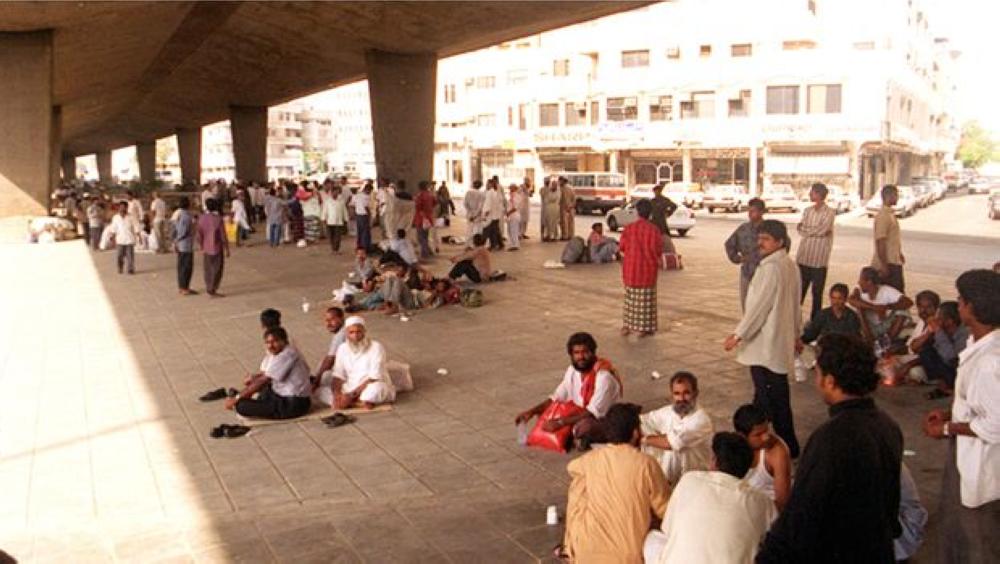
Illegal expatriates wait for Passports Dept. officials to arrest them and deport to their home country. — Courtesy photo

3 minute read
AA
Resize


Saudi Gazette report
JEDDAH – Illegal foreigners have expressed their happiness over the government’s decision to extend the amnesty period by a month, claiming it as a golden opportunity to leave the kingdom without punishment.
“We want to make use of this opportunity,” said one foreign worker who expressed his sorrow for not using the previous three-month-long amnesty period. “We did not know what to do after the end of the previous amnesty period to avoid jail and fine,” he added.
Al-Madina Arabic daily’s correspondent visited Jisr Al-Ummal (laborers’ bridge) in Kilo 7 in South Jeddah, where most illegal workers stay to get jobs. They said they wanted to make use of the royal gesture and leave the Kingdom without punishment.
Assad, a Somali, who engaged in construction work, said he was living in the Kingdom for the last 18 years without iqama (residency permit). I have intruded into the Kingdom more than once. “I stayed first for seven years before Jawazat (Passports Department) officers arrested and then deported me,” he said.
“I returned to the Kingdom again. Now I want to make use of the amnesty and leave the Kingdom as quickly as possible because I don’t know what would be my future if they arrest me and impose punishment for violating the country’s regulations,” he said. At present Assad stays with another person in a house near the bridge and waits everyday for someone to pick him for job.
Bashir Waliyuddin, a Bangladeshi, said he has been working in Jeddah for two years as a plumber. “I go to Jisr Al-Ummal every morning with the hope of finding a job. I stay close to the bridge to save transport fare,” he said. Several Bangladeshis stay together in a single room.
“We did not make use of the amnesty period because we did not want to leave the Kingdom. I am thinking of correcting my legal status this time,” he added.
Shahata Ramadan, an Egyptian said, he has been working in the Kingdom for the last 25 years. He has worked as ironsmith and a painter. “I hold a resident permit with profession of a farmer. My sponsor is a Saudi living in Qassim. I used to pay SR7,000 to him at the time of renewing my iqama and SR1,000 to get exit-re-entry visa,” he explained.
Ramadan said he wanted to make use of the new amnesty period and leave the Kingdom without punishment. “I have worked at different places including Baha, Qassim and Taif. I have got good job opportunities in Jeddah. Sometimes I receive SR1,200 a day.”
He seldom got jobs while in Qassim and requested his sponsor to allow him to work in Jeddah. “I worked in the morning hours for my personal account and in the evening for a company.”
Ramadan pointed out that most workers who stay near Jisr Al-Ummal were not qualified to do any work and they learned different professions after arriving in the Kingdom.
Ibrahim Khalil, a Pakistani, said he holds a resident permit with profession of plumber. Now he has mastered painting. “I was working for a company in the Eastern Province before moving to Jeddah where I found good opportunities. I go to Jisr Al-Ummal every morning seeking customers."
Khalil said he was unaware of the campaign against illegal workers.
Islam Mohammed, also a Pakistani, said he worked as a private taxi driver and paid SR250 every month to his sponsor in Tabuk. “I was not aware of the amnesty and I would like to make use of it this time to correct my legal status to save the money which I pay to the sponsor every month.”
Mohammed Al-Jawadi, an Egyptian, praised the Kingdom and its generous people. “I worked in Jeddah while my sponsor was in Jazan. I have learned many jobs while working in the Kingdom. I would say Saudi Arabia is a good school for foreign workers,” he concluded.


