
Sky is the limit: Drone, new buzzword in India



NEW DELHI — The new buzzword in the Indian tech space is drone. It has caught the imagination of youth, business fraternity and policymakers alike. From wedding photoshoots to border surveillance, utility of drones is multifaceted.
India is constantly updating and upgrading its drone policy to cater to the needs of various sectors, yet keeping in mind national security and privacy.
“The new Drone Rules will tremendously help start-ups and our youth working in this sector. It will open up new possibilities for innovation and business.
“It will help leverage India’s strengths in innovation, technology and engineering to make India a drone hub,” Prime Minister Narendra Modi had said in a tweet earlier.
Drones are unmanned aerial vehicles (UAV). To make the usage and need of various kinds of drones clear to all and sundry, India has made five categories of drone — nano, micro, small, medium and large.
Nano drones are essentially less than or equal to 250 grams, while micro is greater than 250 grams and less than or equal to 2 kg. Small would be more than 2 kg and less than or equal to 25 kg; medium is more than 25 kg and less than or equal to 150 kg and large is more than 150 kg.
Though most of the rules for flying drones are for the bigger drones, but there is a cap for nano drones as well. In India nano drones can be operated within 50 feet and permission is required to fly it in restricted airspace like airports and others.
Drones came very handy during COVID times even. It helped in real-time monitoring of COVID-19 hotspots and containment zones to ensure strict compliance of lockdown guidelines.
The Indian government has announced 'Drone Shakti' in Budget 2022. Finance Minister Nirmala Sitharaman explained that the initiative will also help in establishing Drones-As-A-Service.
In September 2021, the Cabinet also cleared the production-linked incentive (PLI) scheme that shall provide incentives up to 20 percent to the drone manufacturers and drone components over the value addition that they make.
Under the new Drones Rules, the government has enhanced the coverage by drones from 300 kgs to 500 kgs. It would also bring down the permission fees to operate drones.
The government is looking at easing out rules of owning and operating civilian drones in India. However, the government has banned import of drones in India.
The Civil Aviation Ministry stated that those who are flying drones that are beyond 2kgs or for commercial purposes are no longer required to obtain a ‘Remote Pilot Licence’ to operate legally. Now, they would only require a Remote Pilot Certificate.
One can now obtain ‘Remote Pilot Certificate’ from the DGCA-approved drone-training institute after passing the course that would make him eligible to fly micro drones for commercial purposes.
All UAVs will have to be registered and provided with a Unique Identification Number (UIN) before they can be operated.
According to a PwC report “Data on Wings — A close look at drones in India”, the drone space in India is catching up with that in other nations and gaining considerable momentum.
According to 6Wresearch, the Indian UAV market is poised to grow at a CAGR of 18 percent during 2017–23 in terms of revenue. Although these numbers will continue to be led by the long-range UAV segment, medium and mini-UAVs are also poised to register healthy growth.
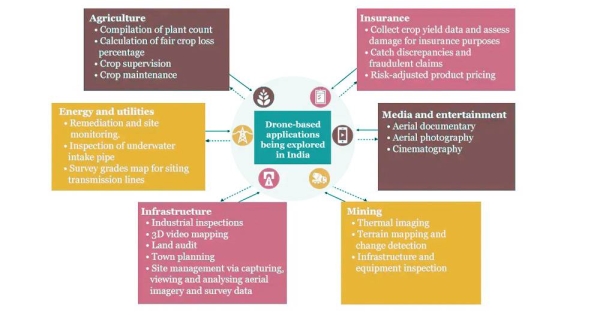
In India there are six segments, in which drone-based applications are being explored. Like agriculture, insurance, energy and utilities, media and entertainment, infrastructure and mining.
Among these, infrastructure and agriculture are seeing the most traction, in line with global trends.
Implementation of drone technology requires an inclusive and collaborative approach that involves aspects like governance, strategic planning, security, regulation and proper awareness. Successful implementation of drone technology requires participation from various stakeholders.
According to a news report by The Print the global market intelligence and advisory firm BIS Research said the global drone market, which is currently dominated by US, China and Israel, will touch $28.47 billion this year and India will comprise about 4.25 percent of that.
According to a report by FICCI, in collaboration with EY, on Unmanned Aircraft Systems (UAS) market, adoption of UAS is increasing in India and it is projected that the value of industry and market would be around $885.7 million.
It gave an example, an autonomous agency of the government of India, responsible for management of a network of National Highways has employed the use of drones for 3D digital mapping for Detailed Project Report (DPR) for road widening for Rae Bareli – Allahabad Highway.
Data collected is being utilized for calculation of compensation of citizens with property rights along the highway.
The report also emphasized drone’s ability to reduce costs of compliance, quality and scope information, enable real time monitoring and manage geographic spread.
When it comes to India, government bodies have been leading the way when it comes to applications of UAS with several large India government bodies and PSUs leveraging the use of UAS in their operations. — Agencies


